



- By: Team Manafethme
- نوفمبر 2, 2026
- 0 Comments
Stairs are always an obstruction for people with mobility concerns. However, the history of stairlifts shows how inventors resolved this problem across centuries. Stairlifts proved to be a reliable solution for people with disabilities to live an independent life. Development in design, manufacturing, and features over time has made stairlifts an accessible aid to the disabled and the elderly. Learning about the evolution of stairlifts will explain why today’s models are comfortable, safe to use, and best to use.
This blog is a complete guide to the evolution and history of stairlifts.
When Was The Earliest Recorded Stairlift?
The answer to the question “when was the stairlift invented” is the 16th century in England. The first mechanical device that resembles a stairlift was designed for King Henry VIII, who was suffering from a deadly disease and couldn’t move across stairs with his weight of about 420 pounds. This stairlift was called the stairthrone. This movable chair was fitted at Whitehall Palace, which helped him move over a 20-foot staircase using servants hauling it- a block-and-tackle system similar to the Mary Rose (one of his warships).
Early History of Stairlifts
After Henry VIII’s device, stairlifts stayed suspended for centuries. The next major step was taken by Frederick Muffett – a carpenter and bear-keeper in Royal Tunbridge Wells, England. He registered his patent in the late 1800s as an “invalid chair with tramway for use on staircases”. His invention’s design is considered the direct ancestor of today’s rail-and-carriage stairlift.
There are some traces showing 1st patented device was registered in the early 20th century. According to account notes, an English patent for a manually operated device was filed in 1913, and its improved version (an electric stairlift) was recorded in 1937. In 1930, a German inventor, Bruno Dick, introduced a motorized lift with a perch seat and is often named the “Father of Stairlifts”.
The First Modern Stairlifts
The first stairlift was invented by an American self-taught engineer, C.C. Crispen, in the 1920s, and gained commercial success. He invented this for his Pennsylvania neighbour who wasn’t able to use stairs due to illness. He sketched his US patent for his neighbour’s sake and named it the “Inclin-ator”. He manufactured a foldable wooden carriage mounted on a steel rail that functioned with an electric motor that moved the platform on rollers. It was operated by the users or switches present at the top/bottom of the stairs.
Crispen, after perfecting the design, formed The Inclinator Company of America. He displayed his patent at the Philadelphia Electric Company’s showroom, combined with print advertising. This boosted his sales, and his early buyers included Thomas Edison, John D. Rockefeller, Groucho Marx, Henry Ford, and Walter Chrysler.
Stairlift Development Through the Decades
After looking into the history of stairlift technology, we get to know about stairlift development through the decades.
- 1930s–1940s: Two American companies, American Stair-Glide Co. and the Cheney Company, increased the demand for stairlifts among people.
- 1950s–1960s: Cable-operated lifts, hydraulic lifts, and perching seats, letting users with disabilities make independent movement.
- 1967 (UK): Stannah built lift systems since 1867and produced its first stairlift in 1975; later in 2011, it shipped the 500,000th unit.
- 1970s: It was the start of the modern stairlift era, including major innovations like user-controlled stairlifts, direct-drive systems, and compact tracking systems.
- 1980s–1990s: Manufacturers added obstacle detectors, faster speeds, and more aesthetically pleasing designs. In 1992, battery operation was introduced, lowering installation costs and improving ride quality. The same year, UK-based Acorn entered the market by remodeling used stairlifts before designing its own affordable models.
- 2000s: In 2001, AmeriGlide became one of the first companies to sell stairlifts online, quickly becoming a leading internet distributor.
How Stairlift Technology Has Evolved
The core mechanism of the stairlift has evolved from a powered chair moving along a rail. This has stayed remarkably consistent since Crispen’s original design. After several refinements, an electric-powered carriage moved along a fixed rail controlled by the user, and this basic principle still applies to all modern stairlifts. However, several changes occurred over time, such as affordability, precision engineering, and safety systems, driven by design and manufacturing advances. Over time, demand for stairlifts grew, creating competition among suppliers and making stairlifts an accessible option for everyone.
Features of Modern Stairlifts
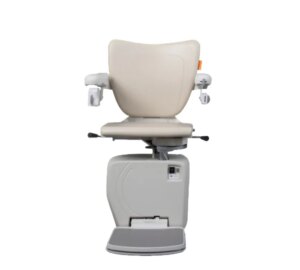
The main purpose of stairlift introduction was to facilitate people with disabilities with easy mobility. This aim is fulfilled with the help of key features installed within stairlifts. Today, there exists a wide variety of stairlifts (all with different required features) to help users select the one that suits their lifestyle best. These are some essential features that modern stairlifts offer:
Compact designs
Stairlifts offer compact designs with slim rails and easy-to-fold seats. This compatibility makes movement easier for users and minimizes obstruction on the staircase.
Foldable seats and footrests
Foldable seats, armrests, and footrests keep stairs clear while the stairlift is not in use. Clearing the stairs when not in use to make stairs free for other family members to use. This feature will make the stair pathway accessible to everyone.
Rechargeable batteries
Stairlifts run with rechargeable batteries. With high-quality performance batteries, stairlifts can work for longer periods, even during a power cut.
Remote controls
Stairlifts are operated using wireless remotes or fixed controls. These controls are easy to use, and users can independently use them to make simple movements.
Improved weight capacity
All latest models come with improved weight capacity. This feature varies across all stairlift types to support a wider range of users’ weights.
Indoor and outdoor models
There are different models of stairlifts for both indoor and outdoor use. Stairlifts are manufactured depending on the areas of use. For instance, outdoor models are made with weatherproof materials to withstand all weather conditions, as compared to indoor stairlifts.
Custom curved rails
Custom curved rails are now also available for places with irregular staircases to make mobility easier for disabled people.
Future of Stairlift Technology
With advances in technology, development of stairlifts will trend towards smart-home integration. Several new smart features, like sensors, increase stairlift reliability. Newer models are more energy-efficient with advanced battery and braking systems. The future of stairlift technology is beyond anyone’s imagination; soon there will be no mobility concerns left. Always choose the right provider for stairlifts. In this, Manafeth Mobility Solutions is known for years for its services and reliable accessible products.
FAQs
When was the first stairlift invented?
According to the records, the first stairlift invented was in mid-1500s for King Henry VIII, whereas the first commercially successful stairlift, “Crispen’s Inclin-ator” was recorded in 1920s.
What is the lifespan of a stairlift?
With proper maintenance, a stairlift lasts for many years. Its lifespan depends on usage, maintenance and model quality.
What is the common name for a stair lift?
Stairlift is also known as chairlift, handicap stairlift, stairway chair lift.
How did the first stairlifts work?
The first stairlift designs used human-electric block-and-tackle systems, while Crispen’s Inclin-ator used a folding mechanism on a steel rail use electric motor. It was operated by controls.